
In the vast universe of letters, “k” stands out like a quirky friend at a party—unassuming yet undeniably essential. It’s the silent partner in words like “knight” and “knowledge,” proving that sometimes, less is more. But don’t let its simplicity fool you; “k” packs a punch in everything from texting to scientific equations.
Overview of “K”
The letter “k” holds significant value in the English language. Its unique sound often appears at the beginning or middle of words, such as in “kite” and “baker.” Silence sometimes accompanies “k,” particularly in words like “knock” and “know.”
Phonetically, it represents a voiceless velar plosive, making it a vital component of pronunciation. Various English dialects pronounce “k” differently, with some speaking more softly than others. Its combination with other letters results in distinctive sounds, such as in “skate” and “key.”
In the realm of linguistics, “k” contributes to diverse phonetic patterns. This contribution enhances the richness of vocabulary and context in communication. For instance, in scientific settings, it often denotes concepts like Kelvin for temperature or the constant in physics equations.
Culturally, the use of “k” extends into modern slang and texting. Words like “K” convey agreement or acknowledgment in casual conversation. Throughout historical linguistics, it has maintained its presence despite the evolution of the language.
Contextual usage remains vital, as “k” plays an essential role in phrases. Its adaptability showcases the flexibility of English, accommodating various expressions and idioms. New terms and trends frequently incorporate “k,” illustrating its continuous relevance in everyday language.
Overall, the letter “k” serves many functions, intertwining with history, culture, and modern communication. Its contributions enrich the English language, displaying simplicity yet immense significance.
Historical Significance of “K”
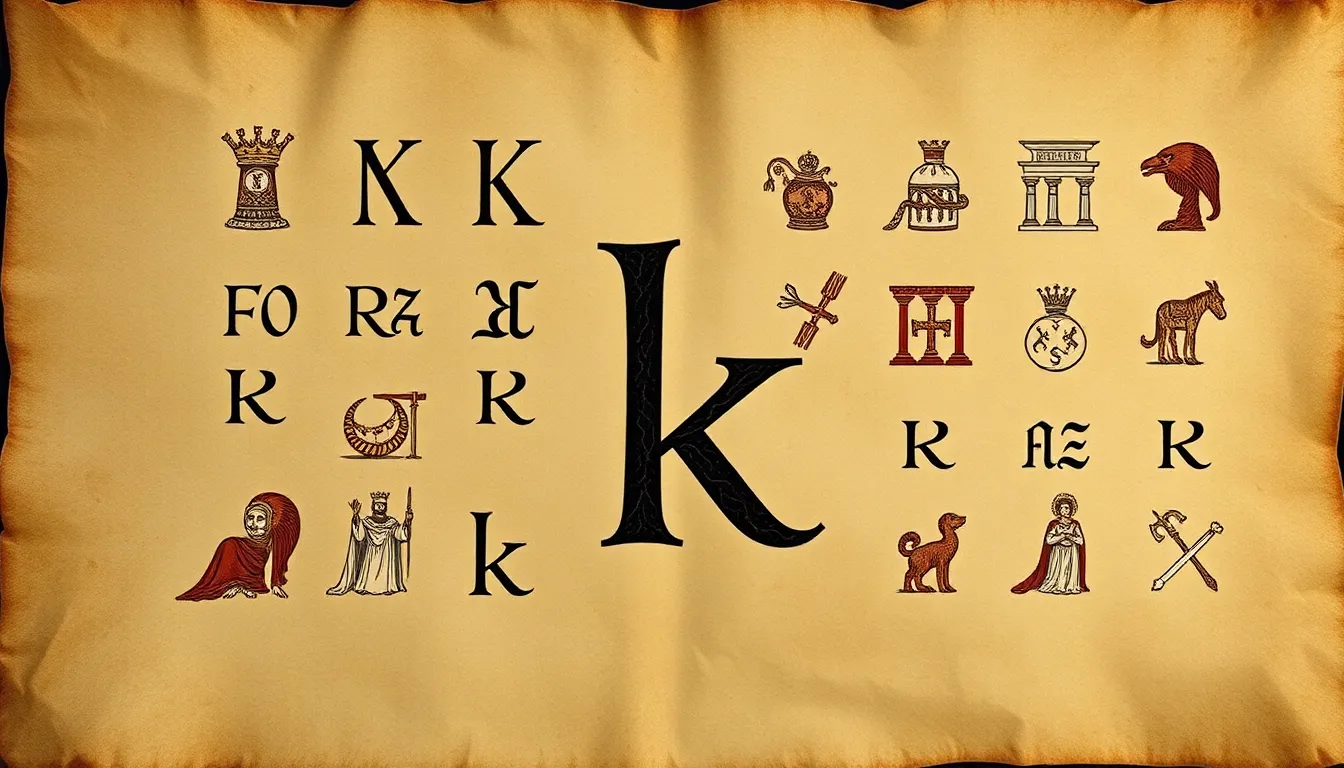
The letter “k” carries deep historical significance in the English language, marking its presence in various contexts.
Early Usage in Language
Early roots trace the letter “k” back to the Phoenician alphabet, where it represented a sound akin to its modern pronunciation. The Greek alphabet borrowed “k” as “kappa,” influencing Latin and its descendants. In Old English, “k” appeared in words like “cyning,” meaning king, reflecting its integral role in royal and noble titles.
Evolution Over Time
Over time, the use of “k” underwent notable changes. During the Middle English period, the letter often replaced “c” before front vowels, simplifying spelling in words such as “kerse” turning into “cherry.” The Great Vowel Shift further contributed to its phonetic evolution, altering sounds and pronunciation. In contemporary English, “k” represents diverse sounds, adapting to slang and abbreviations. This ongoing evolution underscores “k’s” resilience and relevance in language dynamics.
The Role of “K” in Science
The letter “k” plays a crucial role in various scientific disciplines. It often signifies important concepts in chemistry and mathematics.
Chemical Significance
In chemistry, “k” commonly represents the equilibrium constant, a value reflecting the ratio of product concentrations to reactant concentrations at equilibrium. This constant varies with temperature, influencing reaction dynamics. The Boltzmann constant, also denoted by “k,” connects particle energy to temperature, forming a foundational element in thermodynamics. Potassium, the chemical element with the symbol “K,” is vital for biological functions. It regulates nerve impulses and muscle contractions, essential for human health. This multifaceted use of “k” solidifies its importance in understanding chemical reactions and biological systems.
Mathematical Applications
In mathematics, “k” often denotes a constant or variable in formulas and equations, providing clarity in algebraic expressions. It appears in various contexts, such as indices or constants in formulas for geometric sequences. Additionally, “k” is prevalent in statistics, representing the number of successes in binomial distributions. The letter also serves as a parameter in calculus, particularly in limits and inequalities. This versatility reinforces its significance in mathematical problem-solving and analysis across diverse areas of study.
Cultural Impacts of “K”
The letter “k” holds a prominent place in various cultural expressions. Its influence spans literature, arts, and media.
Literature and Arts
In literature, “k” often marks pivotal themes and characters. Authors utilize “k” in character names, such as Katniss in “The Hunger Games,” to evoke certain traits. Poets employ “k” in imagery, creating rhythmic patterns that enhance the reading experience. Symbolism also thrives with “k,” where it represents knowledge, power, or elements of conflict in narratives. Artistic movements frequently adopt “k” in titles or styles too, linking the letter with creative expression. Overall, the letter has made a significant impact, inspiring countless works and interpretations.
Popular Media Representations
Popular media showcases “k” in various forms. Television shows like “Killing Eve” and movies such as “Knives Out” highlight its power in establishing tone and intrigue. Branding often uses “k” in catchy names, drawing attention and creating memorable identities, as seen in global trends like “K-pop.” Social media also harnesses “k,” where it appears in hashtags and slang terms, helping to shape modern communication. Additionally, video games frequently include “k” to create character names and titles that resonate with players. This prevalence in media underscores “k’s” versatility and cultural significance.
The letter “k” showcases its importance across multiple dimensions of the English language. Its historical roots and phonetic versatility highlight its adaptability and relevance. From literature to science “k” continues to play a crucial role in communication and expression.
As language evolves “k” remains a testament to the richness of English. Its presence in modern slang and cultural references further cements its status as a dynamic component of everyday language. Embracing “k” means appreciating the complexity and simplicity it brings to various contexts.


